GitHub Says ‘No Thanks’ to Bots ??? Even if They’re Nice

Nobody wants spam. But even Michaels-Ober, the developer who was at first uncertain about Imageoptimiser’s pull request doesn’t think that an all-out prohibition on GitBots is the way to go if it’s possible to create truly useful GitBots.

“I don’t think this specific behavior should be prohibited,” he says. “And I would hope that GitHub could find a way to change their term of service. It seems like we would be throwing out the baby with the bathwater to say that all bots are bad.”

If you can manage disruptive humans, surely bots aren’t beyond selective treatment.

The 10 highest-rating NBR tech stories of 2012

Content and copyright were hot buttons in 2012. And in keeping with those themes, the best-read technology story of the year was the tale of Fyx – a new Auckland ISP that allowed New Zealanders to access US commercial download services such as Netflix and Hulu, ordinarily blocked to those outside North America.

Fyx briefly gave us a glimpse of what life could like for those willing to pay for online content. Momentarily, we lived in a global village of consumer choice, unshackled from content agreements that are nothing about copyright, and everything about maintaining regional distribution monopolies.

Interest was intense. The story generated 60,000 page impressions, making it the most clicked-on NBR story outside of the Rich List. Clearly, there is a high level of curiosity about any developments in the area of street-legal downloads (an April 2011 piece on using iTunes US gained enough new traffic to stay in the Top 10 for a second year, helped by an update about tapping iTunes Australia). Threats to globally-distributed content, such as the US laws SOPA and PIPA, and the TPP trade deal, also rated highly.


Here’s the 10 tech stories that drew the most traffic:

You Won???t Stay the Same, Study Finds

???Believing that we just reached the peak of our personal evolution makes us feel good,??? Dr. Quoidbach said. ???The ???I wish that I knew then what I know now??? experience might give us a sense of satisfaction and meaning, whereas realizing how transient our preferences and values are might lead us to doubt every decision and generate anxiety.???

Or maybe the explanation has more to do with mental energy: predicting the future requires more work than simply recalling the past. ???People may confuse the difficulty of imagining personal change with the unlikelihood of change itself,??? the authors wrote in Science.

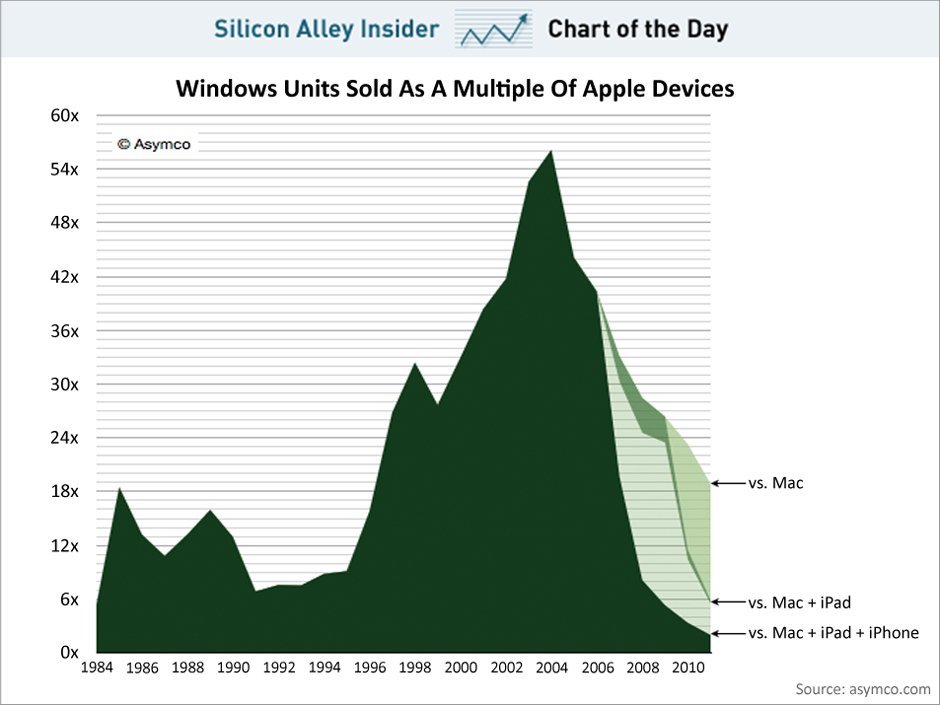
Steve Ballmer’s Nightmare Is Coming True

Almost one year ago today, we laid out the nightmare scenario for Microsoft that could lead to its business collapsing.

After laying it all out, we concluded, “Fortunately for Microsoft, none of this is going to happen.”

We were wrong.

A lot changed in the last year.

Microsoft’s nightmare scenario is actually starting to take hold. We’re revisiting our slideshow from last year to see how things have played out.

And Forbes writes, “Microsoft Is Fast Turning Into A Sideshow.”

Nobody ever got fired…

WCIT, Neutrality, OTT-Telco & "sustainable" Internet business models

I don’t buy the argument that we should reinvent the Internet because some applications work badly on congested networks (eg VoIP and streamed video). My view is that

  1. Users understand and accept variable quality as the price of the huge choice afforded them by the open Internet. 2.5 billion paying customers can’t be wrong.
  2. Most of the time, on decent network connections, stuff works acceptably well
  3. There’s a lot that can be done with clever technology such as adaptivity, intelligent post-processing to “guess” about dropped packets, multi-routing and so forth, to mitigate the quality losses
  4. As humans, we’re pretty good at making choices. If VoIP doesn’t work temporarily, we can decide to do the call later or send an email instead. Better applications have various forms of fallback mode, either deliberately or accidentally.
  5. Increasingly, we all have multiple access path to the Internet – cellular, various WiFi accesses and so forth. Where we can’t get online with enough quality, it’s often coverage that’s the problem, not capacity anyway.
  6. Anything super-critical can go over separate managed networks rather than the Public Internet, as already happens today

Excellent. Many good points on the topics.

The Federal Trade Commission closes its antitrust review

We???ve always accepted that with success comes regulatory scrutiny. But we???re pleased that the FTC and the other authorities that have looked at Google’s business practices???including the U.S. Department of Justice (in its ITA Software review), the U.S. courts (in the SearchKing and Kinderstart cases), and the Brazilian courts (in a case last year)???have concluded that we should be free to combine direct answers with web results. So we head into 2013 excited about our ability to innovate for the benefit of users everywhere.

???Antifragile,??? by Nassim Nicholas Taleb

In Mr. Taleb???s view, ???We have been fragilizing the economy, our health, political life, education, almost everything??? by ???suppressing randomness and volatility,??? much the way that ???systematically preventing forest fires from taking place ???to be safe??? makes the big one much worse.??? In fact, he says, top-down efforts to eliminate volatility (whether in the form of ???neurotically overprotective parents??? or the former Fed chairman Alan Greenspan???s trying to smooth out economic fluctuations by injecting cheap money into the system) end up making things more fragile, not less. Overtreatment of illness or physical problems, he suggests, can lead to medical error, much the way that American support of dictatorial regimes ???for the sake of stability??? abroad can lead to ???chaos after a revolution.???