Don???t trade away our digital future | InternetNZ

Finally, another innovation-killing US proposal worth mentioning eludes the understanding of some of the brightest people I have ever met ??? people who have a rigorous knowledge of the Internet and how it works. This is the proposal that would give copyright owners an exclusive right over temporary electronic copies.

While it took me a while, finally the threat arose. It’s not so much that the operators of caches will have to do all the intrusive things that are mentioned, they won’t.

What the rights holders seek here is the ability to tax cache operators (and that is a wider class than just ISPs). Like this: “We know, and you know, there will be some copyright material cached which has not been licensed, and you can either ferret it all out at great expense, or pay us a simple blanket licence to excuse you.”

Collection agencies have been doing this for sometime, so you can’t play a radio in business where the customers can hear it, without paying the vig. You must pay them a cut even if you don’t play copyright music, but any music at all.

Examples: http://torrentfreak.com/tag/royalties/

The other version of this is “ephemeral rights,” where radio stations buy a record, and for convenience dubs (AKA copy) it to a cartridge for air-play. That’s convenient, that’s value, there’s a right…

Susan uses the example of your heart’s indifference to what it pumps, the vampire at your neck is similarly indifferent, as long as they get their fangs in the vein.
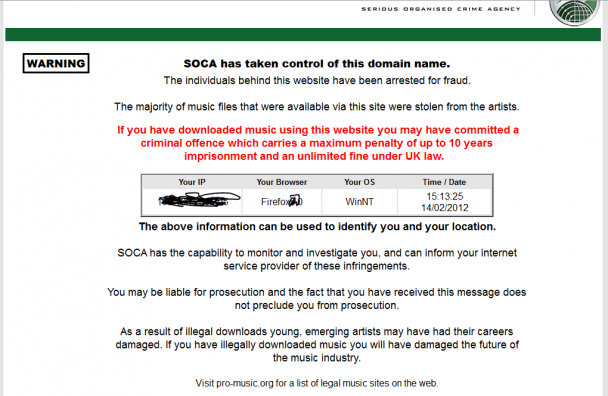
Megaupload Trial May Never Happen, Judge Says

Megaupload???s lawyer adds that he doesn???t understand why the US authorities weren???t aware of this problem before. As a result Judge O???Grady noted that Megaupload is ???kind of hanging out there.???

If this issue indeed prevents Megaupload from being tried in the US, it would be a blunder of epic proportions. And it is not the first ???procedural??? mistake either.

Well, “hanging” was the goal. Mission accomplished.

Roadshow Films Pty Ltd v iiNet Limited

Firstly, in the law of authorisation, there is a distinction to be drawn between the provision of the ‘means’ of infringement compared to the provision of a precondition to infringement occurring. The decisions in Moorhouse, Jain, Metro, Cooper and Kazaa are each examples of cases in which the authorisers provided the ‘means’ of infringement. But, unlike those decisions, I find that the mere provision of access to the internet is not the ‘means’ of infringement. There does not appear to be any way to infringe the applicants’ copyright from the mere use of the internet. Rather, the ‘means’ by which the applicants’ copyright is infringed is an iiNet user’s use of the constituent parts of the BitTorrent system. iiNet has no control over the BitTorrent system and is not responsible for the operation of the BitTorrent system.

Quote from the initial case (appeal having just been “dismissed with costs.”)  Structural separation of the access and the application seems to have been part of the first decision.

It emphasises the importance to ISPs of *not* controlling (as common carriers should not) the activities of their users, to avoid the threat of “authorisation” and in Canada, the liability for broadcast regulations including associated levies (http://hamishmacewan.posterous.com/supreme-court-rules-isps-not-subject-to-br…

Just what is the Java API anyway? – JavaWorld

The Java API is the set of classes included with the Java Development Environment. These classes are written using the Java language and run on the JVM. The Java API includes everything from collection classes to GUI classes. You can view a complete listing of the Java API at: “Java 2 Platform, Standard Edition, v 1.3.1 API Specification.”

Tutorials are also available at: “Java Tutorial.”

Ah, like intrinsics or libraries?

How’s that three strikes thing working out, anyway?

So not one notice about TV or movies but also not a single notice has been sent relating to copying of New Zealand content. Not one.

The rights holders in New Zealand put together an ad campaign based on the destruction of value of New Zealand content, yet it hasn???t defended a single New Zealand artist. I find that very interesting ??? from a PR point of view it???s a massive cock-up because at the very least they could have found one to point to. Either they don???t care enough to pay $25 or there simply isn???t any piracy of New Zealand artists going on in New Zealand. Isn???t that an interesting thought?

The MED review allows for public submissions on its discussion document but comments must be received by 30 April. Have a look at the document and send any thoughts you may have to the MED here.  Because despite its obvious flaws, as far as I can tell the Copyright Act is working ??? it???s the US-based rights holders that aren???t.

It appears the US industry is very willing to fund lobbying of NZ legislators, but not put much into making legitimate channels available to customers. At least we now know who the legislation serves, and it ain’t us, the ones paying for the enforcement.

The numbers behind the Copyright Math

A few weeks back, I gave a short TED talk about ???Copyright Math.??? Since TED draws both Hollywood and Silicon Valley bigwigs, I thought it would be a great venue for raising certain rights issues that have been a sore point between the two industries for years. But January???s brawl over the proposed SOPA law was a raw and recent memory. So I decided to make my talk playful, rather than sermonizing. Everyone can laugh at silly infographics. And who DOESN???T want to deface a Leave-it-to-Beaver-like Christmas scene with pirate-and-Santa graffiti?

Since the talk was so short, I couldn???t dive deeply into the numbers and sources that I based it on (which would have shattered the whimsical tone anyway). But even my silliest numbers were derived from actual research, performed by an actual Copyright Mathematician (me, that is). So I thought I???d use this blog post to put my sources and calculations out there for anyone who???d like to nerd out on the details.

Same old, but like, funny. Except perhaps for Kim Dotcom.

Apparently copyright mathematicians can go on to this line of work:

“This has not, however, stopped their earnings from pushing back the boundaries of pure hypermathematics, and their chief research accountant has recently been appointed Professor of Neomathematics at the University of Maximegalon, in recognition of both his General and his Special Theories of Disaster Area Tax Returns, in which he proves that the whole fabric of the space- time continuum is not merely curved, it is in fact totally bent.”

Copyright isn’t dead just because we’re not willing to let it regulate us

The inability of copyright to regulate cultural activity isn’t anything new. It’s probably true that this inability reduces the profitability of some entities in the entertainment industry’s supply chain, just as it increases others’. But that’s just a question of profit maximisation, not survival.

The problem is that the entertainment companies treated the increased ease of copying in the age of the internet as a signal that copyright should be expanded to cover more people and more activities, far outside of the entertainment industry. What they should have done is picked a new proxy for “this is an industrial activity within copyright’s scope” and soldiered on regulating themselves, without trying to regulate the whole world at the same time.

It’s time to stop declaring copyright dead because we aren’t willing to let it be the ultimate regulator of everything we do with a computer.


Judge Orders Failed Copyright Troll to Forfeit ‘All’ Copyrights

Righthaven, a copyright-troll law firm that failed in its attempt to make money for newspapers by suing readers for sharing stories online, was dealt a death blow Tuesday by a federal judge who ordered the Las Vegas company to forfeit ???all of??? its intellectual property and other ???intangible property??? to settle its debts.

Patent is not alone in being an abused “IP.” But sometimes abusers are punished.