Monthly Archives: January 2013
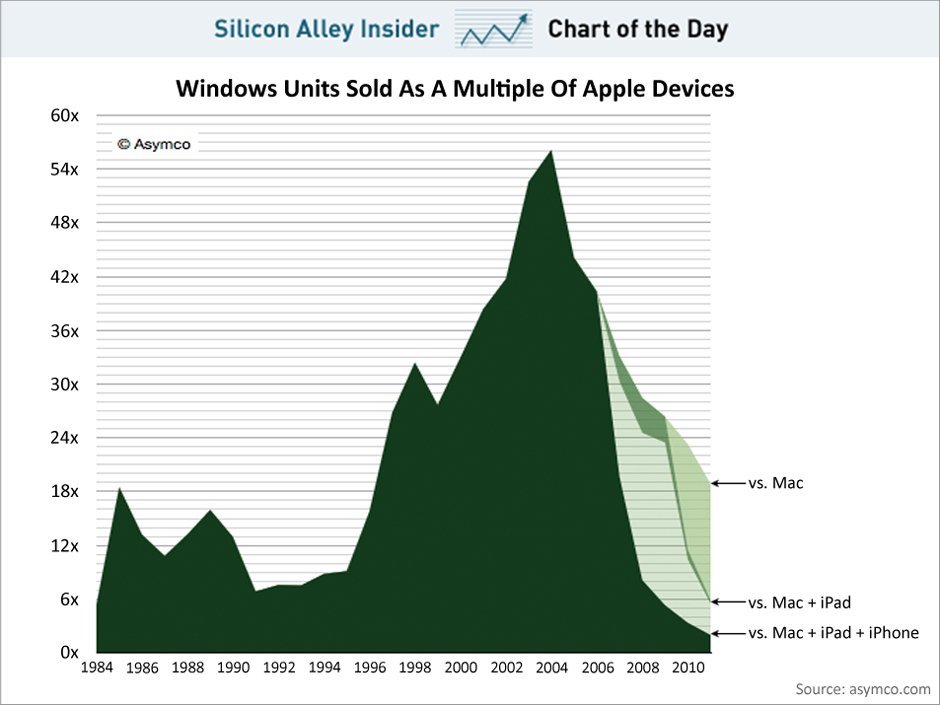
Steve Ballmer’s Nightmare Is Coming True
Almost one year ago today, we laid out the nightmare scenario for Microsoft that could lead to its business collapsing.
After laying it all out, we concluded, “Fortunately for Microsoft, none of this is going to happen.”
We were wrong.
A lot changed in the last year.
Microsoft’s nightmare scenario is actually starting to take hold. We’re revisiting our slideshow from last year to see how things have played out.
And Forbes writes, “Microsoft Is Fast Turning Into A Sideshow.”
Nobody ever got fired…
WCIT, Neutrality, OTT-Telco & "sustainable" Internet business models
I don’t buy the argument that we should reinvent the Internet because some applications work badly on congested networks (eg VoIP and streamed video). My view is that
- Users understand and accept variable quality as the price of the huge choice afforded them by the open Internet. 2.5 billion paying customers can’t be wrong.
- Most of the time, on decent network connections, stuff works acceptably well
- There’s a lot that can be done with clever technology such as adaptivity, intelligent post-processing to “guess” about dropped packets, multi-routing and so forth, to mitigate the quality losses
- As humans, we’re pretty good at making choices. If VoIP doesn’t work temporarily, we can decide to do the call later or send an email instead. Better applications have various forms of fallback mode, either deliberately or accidentally.
- Increasingly, we all have multiple access path to the Internet – cellular, various WiFi accesses and so forth. Where we can’t get online with enough quality, it’s often coverage that’s the problem, not capacity anyway.
- Anything super-critical can go over separate managed networks rather than the Public Internet, as already happens today
Excellent. Many good points on the topics.
The Federal Trade Commission closes its antitrust review
We???ve always accepted that with success comes regulatory scrutiny. But we???re pleased that the FTC and the other authorities that have looked at Google’s business practices???including the U.S. Department of Justice (in its ITA Software review), the U.S. courts (in the SearchKing and Kinderstart cases), and the Brazilian courts (in a case last year)???have concluded that we should be free to combine direct answers with web results. So we head into 2013 excited about our ability to innovate for the benefit of users everywhere.
Ah ha!
Alain de Botton @alaindebotton
The middlebrow, alarmed that education can’t guarantee status, reserve particular venom for those they fear might ‘dumb down’ culture.
via twitter.com
???Antifragile,??? by Nassim Nicholas Taleb
In Mr. Taleb???s view, ???We have been fragilizing the economy, our health, political life, education, almost everything??? by ???suppressing randomness and volatility,??? much the way that ???systematically preventing forest fires from taking place ???to be safe??? makes the big one much worse.??? In fact, he says, top-down efforts to eliminate volatility (whether in the form of ???neurotically overprotective parents??? or the former Fed chairman Alan Greenspan???s trying to smooth out economic fluctuations by injecting cheap money into the system) end up making things more fragile, not less. Overtreatment of illness or physical problems, he suggests, can lead to medical error, much the way that American support of dictatorial regimes ???for the sake of stability??? abroad can lead to ???chaos after a revolution.???
via nytimes.com
2013 Award Categories : Institute of Public Administration New Zealand
Integrity and Trust
Sponsored by the Justice Sector (the Ministry of Justice, the New Zealand Police, the Department of Corrections, the Crown Law Office and the Serious Fraud Office)
New Zealand has one of the most honest public services in the world. The work done by public servants deserves to be valued and trusted. The Justice Sector Award for Excellence in Integrity and Trust recognises the importance of that trust ??? and that it is hard won and easily lost. The best programme of projects will be those where the organisation can demonstrate that people thought creatively about how to meet the highest standards of integrity and build trust with the people and communities they serve, or how to do the right thing where the normal rules or responses may not be enough.
via ipanz.org.nz
Can evolution explain high-heeled shoes?
Only fools claim to know the future
People crave specific knowledge of the evolution of complex systems, paying good money for the services of clairvoyants and economic forecasters. But such knowledge is rarely available. Nor, even if it were available, would it often be useful. Physicists studying sport have established that many fieldsmen are very good at catching balls, but bad at answering the question: ???Where in the park will the ball land???? Good players don???t forecast the future, but adapt to it. That is the origin of the saying ???keep your eye on the ball???.
As complex systems go, the interaction between the ball in flight and the moving fieldsman is still relatively simple. In principle, most of the knowledge needed to compute trajectories and devise an optimal strategy is available: we just don???t have the instruments or the time for analysis and computation. More often, the relevant information is not even potentially knowable. The skill of the sports player is not the result of superior knowledge of the future, but of an ability to employ and execute good strategies for making decisions in a complex and changing world. The same qualities are characteristic of the successful executive. Managers who know the future are more often dangerous fools than great visionaries.
Most people who hire fortune tellers have the good sense to treat their prognostications lightly. The activity is casual fun, its value ??? if any ??? is as provocation to think carefully about the present rather than a measure of gaining knowledge about the future. Good predictions may be available in structured, well-ordered, situations ??? but, even then, forecasts are properly conditional or probabilistic. There are few certainties about the future: but one is that hedgehogs who make confident statements on the basis of some universal theory will be as persistently misleading counsellors in the future as in the past. And that the foxes, like Mr Silver, who scramble everywhere for scraps of information will provide better, if more nuanced, advice.
via johnkay.com
Reality-based community – Wikipedia, the free encyclopedia
The source of the term is a quotation in an October 17, 2004, The New York Times Magazine article by writer Ron Suskind, quoting an unnamed aide to George W. Bush (later attributed to Karl Rove[1]):
The aide said that guys like me were “in what we call the reality-based community,” which he defined as people who “believe that solutions emerge from your judicious study of discernible reality.” … “That’s not the way the world really works anymore,” he continued. “We’re an empire now, and when we act, we create our own reality. And while you’re studying that reality???judiciously, as you will???we’ll act again, creating other new realities, which you can study too, and that’s how things will sort out. We’re history’s actors???and you, all of you, will be left to just study what we do.”[2]
[edit]
via en.wikipedia.org
Oh, that reality-based community…
 Hamish MacEwan